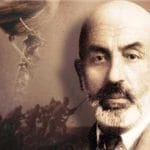
Esteemed Mehmet Akif Ersoy,
First of all, I ask you to accept my sincere apologies. It is not an excuse, but whenever I take pen in hand to write you a reply, the words always get stuck in my throat. I do not know exactly why; perhaps it is because, although I feel close to your honorable life and luminous mind, I cannot decide whether I am being unfair to you by not approving of your leaving in resentment. For I can say that, in your person, I see the century-long fate of the entire religious-conservative stance. One way or another, I have always had a paradoxical relationship with you.
You know, our conversations are what we are able to say. We always conceal our true feelings and thoughts. What we say is filled with the codes of what we do not say. We do not like to speak plainly and clearly. That is why our best poets are the authors of the most encrypted poems. With your permission, I will try to speak openly with you.
Akif Bey,
It is a rule of dialectics that the new is born from the old and eliminates it. If the Republic is to be founded, the Ottoman Empire must pass; if Mustafa Kemal is to live, Enver Pasha must go; if Kemalism is to prevail, Unionism must ‘die.’ Having joined the Committee of Union and Progress in 1908, become a member of the Special Organization in 1915, and actively participated in the War of Independence between 1916 and 1921 in short, having experienced all stages of the great collapse from within, I don’t think you failed to see this dialectic in 1923. Moreover, at a time when the Lausanne negotiations had been concluded that is, when it was understood that the “new” would be forcibly accepted by the defeated side, your leaving the country in resentment needs to be analyzed with complete clarity.
When you left the country in 1925, you told a friend, “They’re sending police detectives after me. I cannot endure being treated like men who sold their homeland and betrayed the country, and that is why I am leaving.” The “installation of the new order,” which began with the killing of Ali Şükrü Bey from the opposition group in Parliament in 1923, frightened many people like you who had roots in the Unionists and the Special Organization. Moreover, you are one of the founding leaders of the Organization and the closest friend of Kuşçubaşı Eşref Sencer, Enver Pasha’s right-hand man. In other words, just as those tried in the Independence Tribunals of 1925 and 1926 saw no regard for identity, for their past, their patriotism, services, or “tears,” it becomes clear that being the poet of the National Anthem carried little weight at moments of sharp transformation. Between 1923 and 1926, loyalty to the new order and new cadres, and the purge of those who did not submit from the old order and cadres, became the sole valid rule. What I do not understand is this: how should we interpret your amazement and sorrow at being followed by police detectives, given your close ties with such prominent Unionists as Kuşçubaşı Eşref and the family of Said Halim Pasha?
Is your amazement the product of the innocence in your nature that dislikes politics, and your sorrow the delicacy in your pious and poetic soul? Or are you the symbol of a strange devotion standing at the very center of so many power games, yet seeing none of them, working only for the country and public service?
I ask these questions because of the resentment behind your voluntary exile to Egypt and your silence between 1925 and 1936. Whom and what were you resentful toward, Akif Bey? What did you expect to happen? What did you want? Did you not know that those who sit at the table after the war and take part in negotiations carry out the requirements of the agreements? Either you would have been among those who sat at the table, or you would not have been so astonished by their “carrying out the requirements.” This is the real question I want to ask you regarding your stance.
What state of mind allows others to sit at the table?
Even today, this is the question whose answer is not sufficiently contemplated, yet which imposes itself after every purge. To be involved in the power game only peripherally, without being in the middle of it? To engage in politics without understanding any of its rules or tools? To enter a fight but pretend not to be? To be upset when you lose? To be unable to even comprehend who you lost to or why?
Akif Bey, in your attitude I see, in essence, all the losers of our political history. Please do not take offense! I wonder whether your overly modest and well-intentioned personality, which is also the source of your pure and sincere piety, might be one of the reasons for this political ineptitude. It seems that a form of religiosity that develops on the basis of such a personality trains the human constitution to live constantly within limits, restrictions, and obligations.
However, the art of politics, whose boundaries and rules are determined by the ‘ambition to reach the goal’, naturally cannot tolerate such delicacy. A guilt-laden psychosis based on fear believing that even violating simple rules will be punished and lead to burning in hell, casts upon a person a heaviness and sluggishness that prevents the agile maneuvers required in the face of concrete realities and ruthless developments. People who perceive everything together with God, explain everything through Him, and live with Him naturally become bewildered novices, hands and feet tangled, when faced with a political “game” in which God is absent.
So, I wonder, Akif Bey, could a connection be made between your own piety and political incompetence? I don’t know, perhaps I’m being unfair, but I think that in order to raise the generations of Asım you express in your poems and to reach brighter days, that is, to achieve your goals, it is necessary to overcome you by criticizing you. I hope you won’t misunderstand this as disrespect to your memory, because on the contrary, I am seeking the answer to how your true memory can be preserved. Or let me put it this way; I believe that the only way for the children of this nation to stop being mere pawns in endless ideological, ethnic, or religious games and become actors in a powerful political system is to overcome your unfortunate fate. Apart from that, be assured that your painful, tragic, yet honorable life story will always be a guide for us and for our children.
To those who ask what it means to have a cause, what patriotism is, what it means not to sell one’s pen, to prefer honor to hunger, to be consistent in word and essence, not to abandon one’s beliefs and values, to think rightly, to be an enlightened believer, we will always point to you as exemplary personality.
We will say, “Akif.” Look at him, read him, water the flower on his sorrowful grave. We will say that he was a true man, one this nation can be proud to have.
To those who ask who an ‘intellectual’ is, we will point to you. Look at “Akif,” who lived his entire life in poverty, who did not even take the money award for the National Anthem, and when it was forced upon him, he donated it to a charity. We will say; do not be among those merchant-intellectuals who turn with every passing wind, who take their ideas from those who give money, who show hostility even to their own country with the language of a fifth column activists, who belittle their nation and feel ashamed of their identity.
To those who ask who is a ‘man among men,’ we will point to you. We will say: be like “Akif.” Be like Akif, who served his sick wife throughout his life; be like ‘Akif,’ who wrote poems for his wife such as:
“I ran and struggled to lift you into a light,
O! My life companion through all the waves of my life.
Was it a mountain or a stone that opposed me, I crossed them all; but
This time it was my own stone that struck my wrinkled brow!”
To those who ask what fidelity to beliefs and values looks like, we will point to you. We will point to Akif, who burst into tears upon reading the lines in a letter written to you by Kuşçubaşı Eşref in 1931; “My dear Akif, I have a Greek neighbor in Cyprus who migrated from Aydın during the population exchange. Recently he went to Istanbul. Upon his return he told me, ‘Your Turks have decided to become like us. If they were going to resemble us this much, why was so much blood shed? They should have left them to us; we would have made them like ourselves by easier means.’” We will point to Akif, who had the Qur’anic translation he wrote burned so that it would not be used as a tool in efforts to distort religion; to Akif who cried out,
“My Lord! I am so overwhelmed, where is Your light, where Your forgiveness?
Will the Hell keep parading me across the horizons of separation?”
To those who ask what patriotism is, how devotion should be, we will point to you. We will point to Akif, who in 1916, when setting out on a journey to Najd on behalf of the Special Organization to organize Ibn Rashid against Sharif Hussein, refused the money offered to be left at his home, saying, “Shall we kill a service we believe to be for the good by striking it with gold?”; We will point to Akif, who said, “My dear Eşref, we sought to build our material and spiritual being through our own sincere feelings and our selfless emotions that seek the positive, the good, and the right. Perhaps the highest feeling in humanity is this: to find one’s way and walk in the direction of one’s own conscience and sound judgment, even against society.”
To those who ask what it means for a country to be ungrateful to its own children, what it is like for a great state to fall into the hands of “small men,” we will show your funeral, Akif Bey.
We will show that even in the final days you spent in your homeland, when you were ill, your house was kept under surveillance; and that after your death, while the official authorities did nothing, the university students, “Asım’s” youth, who took directorate of your funeral and carried your coffin, wrapped in the Kaaba cloth and the flag, on their shoulders to Edirnekapı, were identified one by one and reprimanded by their school administrations.
We will show that despite your poverty, despite the fact that you had served as a deputy in Parliament, you were not granted a pension, nor even given any work. We will show the despicable attitudes of those who were nowhere to be seen during the National Struggle, when you were traveling through Burdur, Kastamonu, Konya, Afyon, and Eskişehir at Kemal’s order, calling the people to resistance through sermons, yet who in the 1920s appeared in Ankara as if they were the owners of the new order, scolding you and causing your “resentment.” To those who ask, how can a person not be understood or misunderstood?, we will point to the truly “reactionary” conservatives who felt raw about the fact that your taking Muslim intellectuals who emphasize reason and renewal, such as Jamal al-Din al-Afghani and Muhammad Abduh as role models. We will show those chronic “rightists” who published your “Safahat” and, in its preface, tried to appropriate you away from yourself, claiming “you were not a Unionist,” supposedly keeping Akif apart from their obsessions with a “right-wing” hatred of the Unionists. We will show the so-called Islamists who could not “grasp” that the newspapers Sebilürreşad and Sırat-ı Müstakim, which you published with Eşref Edip, were the organs of the Islamist wing of the Committee of Union and Progress.
To those who ask how injustice can be done to the poet of a nation’s National Anthem, we will show you.
We will show them how, during the coup days, the National Anthem was forced upon people in prisons at gunpoint, how it was used as torture in schools, how it was reduced to a formal ceremony consisting of old words stripped of its content and meaning, and how those who feel raw about the spirit of independence but could not give up its benefits used the 10th Year March against you. We will always love you and we will teach you to our children as well, Akif Bey.
That is why I believe it is necessary to criticize you and to transcend you by internalizing you. Because you were never left where you were, and you were instead used as material by a bizarre, later-emerging right-wing religiosity, a hollow political ideology built on always losing and empowering the winners. Rescuing you from the hands of these “almond-moustached” types who have embraced opposition as destiny, who are deemed to have lost even when they win, who cannot shake off a psychology of guilt and illegitimacy, who try to exist with a withdrawn and timid personality, with a fearful, downcast soul, and with a hypocritical language, is our bounden duty.
Taking the inspiration from where you left off in resentment, from where you stopped because you could not go on, and making it speak to the understanding of our age is our binding duty…
And we also owe it to see, in Ankara, the grandchildren of those who once scolded you. We owe you much, as you can see. With that merciful side of yours, please do not erase your claims… No, please, be a “hawkish” on this matter. Act politically, do not withhold your anger… And please, do not forgive this country, this nation, and us, until we have compensated for your shortcomings and deficiencies.
Akif Bey…!
I respectfully kiss your hands and entrust you to the Oneness of God!
Rest in mercy!
* Source: Açık Mektuplar, Ahmet Özcan-Yarıın yay. 2016
*Safahat, M.Akif Ersoy, E. Düzdağ, İst. 1992
**Tarih sohbetleri,1,2,3,Cemal Kutay, İst. 1967